AMERICA BRACES FOR HIGH-STAKES MIDTERM ELECTIONS AS POLITICAL DRAMA, LEGAL BATTLES AND PARTY DIVISIONS INTENSIFY
Updated: 12 hours ago
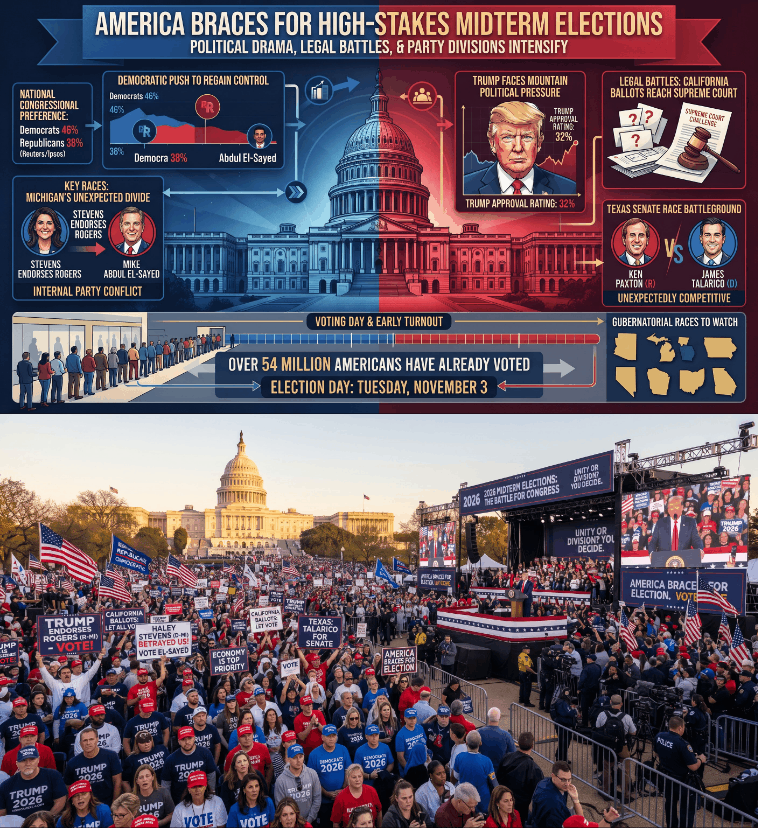
Trump faces voter dissatisfaction as Democrats push to regain congressional control; controversial endorsements and ballot disputes add tension ahead of Election Day
WASHINGTON, D.C. — November 2, 2026 — The United States is preparing for a politically consequential Election Day on Tuesday, November 3, as Republicans and Democrats make their final appeals to voters in a midterm election that could reshape the balance of power in Washington.
With control of Congress hanging in the balance, the campaign has become increasingly contentious, with political infighting, controversial endorsements, courtroom battles over ballots and growing concerns about the economy dominating the final days before voting.
President Donald Trump has emerged as a central figure in the election, despite the fact that he is not personally seeking reelection. His administration's policies, public approval ratings and handling of major national issues have become important factors in congressional races across the country.
Trump faces mounting political pressure
---------------------
A Reuters/Ipsos poll released Monday placed Trump's approval rating at 32%, close to the lowest level recorded during his presidency. The same poll showed Democrats leading Republicans 46% to 38% in the national congressional preference survey.
The cost of living remains a major concern, with 78% of respondents identifying it as a very important or top issue influencing their vote. Inflation, grocery prices, fuel costs and economic uncertainty are among the concerns weighing on voters.
The administration's handling of the Iran war has also become a political issue, adding another challenge for Republicans seeking to maintain their congressional majorities.
Democrats are hoping voter dissatisfaction will translate into victories, particularly in competitive House districts. However, Republicans are counting on strong Election Day turnout to protect their positions.
Democratic Party faces unexpected internal conflict in Michigan
-------------------------
One of the most surprising political developments emerged in Michigan, where Democratic Congresswoman Haley Stevens publicly endorsed Republican Senate candidate Mike Rogers over her own party's nominee, Abdul El-Sayed.
The endorsement stunned Democratic officials and sparked criticism from Senate Minority Leader Chuck Schumer, who described the move as a betrayal.
The disagreement has exposed divisions within the Democratic Party at a particularly sensitive moment, as the party attempts to regain control of the Senate.
The controversy has also raised questions about whether internal party disagreements could weaken Democratic candidates in closely contested races.
Legal battle over California ballots reaches Supreme Court
-------------------
Another major controversy involves California, where the Trump administration is challenging approximately 20,000 mail ballots associated with individuals it believes may not be eligible to vote because of citizenship concerns.
The Justice Department has sought to have the ballots temporarily set aside while the eligibility questions are investigated.
California officials have strongly disputed the administration's position, arguing that the federal government's list may include eligible American citizens and people whose voter registrations are no longer active.
Federal courts previously rejected the administration's request to separate the ballots, citing concerns about potentially disenfranchising eligible voters.
On Monday, the administration took its challenge to the U.S. Supreme Court, creating another significant legal dispute on the eve of Election Day.
The controversy has intensified the national debate over election security, voting rights and the federal government's authority over state election procedures.
Texas Senate race becomes an unexpected battleground
------------------
Texas is attracting considerable national attention as Republican Ken Paxton faces Democrat James Talarico in a surprisingly competitive Senate contest.
Texas has traditionally been a Republican stronghold, but the race has drawn attention because Democrats see an opportunity to challenge Republican dominance in the state.
Paxton's political history, including his previous impeachment proceedings and legal controversies, has become part of the campaign discussion.
The outcome could have significant implications for the Republican Party's efforts to retain control of the Senate.
More than 54 million Americans have already voted
-----------------------+
Early voting has been substantial, with more than 54 million Americans reportedly casting ballots before Election Day, according to the University of Florida's election tracker.
Election officials are preparing for another major turnout as polling locations open nationwide Tuesday.
However, political analysts caution that early voting numbers alone cannot predict the final outcome. The distribution of those votes, party enthusiasm and Election Day participation will all play important roles.
Governors' races add another layer to the political battle
--------------------
The congressional elections are not the only contests attracting attention.
Approximately three dozen gubernatorial races are being decided this election cycle, with both parties fighting for influence at the state level.
Among the closely watched contests are races in Arizona, Michigan, Iowa, Nevada and Wisconsin.
Some campaigns have become particularly aggressive. In Ohio, the gubernatorial contest between Republican Vivek Ramaswamy and Democrat Amy Acton has attracted attention over a controversial political advertisement involving Acton's estranged mother.
In Georgia, Democrat Keisha Lance Bottoms is seeking to make history with a bid to become the state's first Black woman elected governor.
What happens if Democrats win?
The biggest question surrounding Tuesday's election is whether Democrats can break the Republican Party's control of Congress.
A Democratic victory in the House could open the door to increased congressional investigations, greater scrutiny of the Trump administration and challenges to Republican legislative priorities.
A change in Senate control would carry even greater consequences for judicial appointments, executive nominations and the administration's legislative agenda.
Republicans, meanwhile, are working to convince voters that maintaining their congressional majorities is essential to continuing the president's policy agenda.
A defining moment for American politics
------------------++
Beyond the individual candidates and political parties, the 2026 midterm elections reflect a country deeply divided over its economic direction, immigration policies, foreign affairs, voting rights and the future of American leadership.
For Republicans, the election represents an opportunity to maintain political control and strengthen the president's influence during the remainder of his term.
For Democrats, it is an opportunity to regain power, challenge the administration and demonstrate that voters are dissatisfied with the country's current direction.
With political tensions rising and several races expected to be closely contested, the nation now turns its attention to Tuesday's vote.
One thing is certain: the outcome could have consequences far beyond Election Day, potentially reshaping the political direction of the United States for the next two years.
Comments